


Table of Contents
Introduction
The search term gaming corner zap-internet brings together two ideas that matter to modern gamers: a dedicated place to play and an internet connection capable of supporting online gaming reliably. The phrase appears in ZAP Internet’s gaming-focused content, where “Gaming Corner” is used as a category covering gaming and related technology topics. ZAP Internet describes itself as a website focused on gaming, gadgets, smart-home technology, news, reviews, and guides.
However, there is an important distinction to make at the beginning. Gaming corner zap-internet is not an established technical standard such as Wi-Fi, Ethernet, fibre-to-the-home, or a recognized networking protocol. The available ZAP Internet material uses the term in the context of gaming spaces, internet connectivity, equipment, and gaming experiences rather than defining it as an independently standardized technology.
For Canadian readers, that distinction is useful because online gaming performance depends on several measurable factors. Download speed matters, but so do latency, jitter, packet loss, network congestion, router performance, connection type, and the distance to a game’s server. The CRTC specifically recognizes latency, jitter, and packet loss as important aspects of broadband quality, including for real-time applications such as multiplayer gaming.
This guide explains what gaming corner zap-internet appears to mean, how the concept relates to Canadian internet connections, which network characteristics matter for gaming, how to build a practical gaming corner, and what readers should verify before treating marketing claims as technical facts.
What Is Gaming Corner Zap-Internet?
The simplest way to understand gaming corner zap-internet is as a gaming-focused concept that connects the physical gaming environment with the quality of its internet connection.
ZAP Internet currently has a dedicated Gaming Corner section on its website. The section contains gaming-related articles, including material discussing gaming spaces, internet connectivity, equipment, social play, and other aspects of digital entertainment.
One ZAP Internet article describes a Gaming Corner as a local gaming hub that can combine gaming hardware, internet connectivity, organized play, and community activities. Another article discusses the idea as a place where players can meet, play, and stream. These descriptions show that the term can be used in a broader sense than simply referring to an internet connection.
That makes the phrase easier to understand when it is broken into its components.
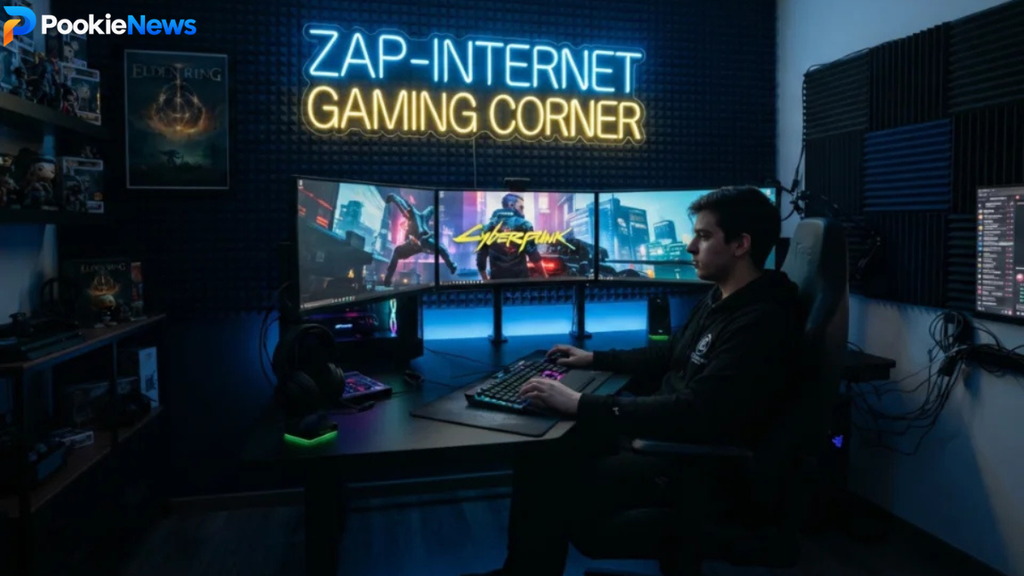
A gaming corner is the physical or virtual environment in which gaming takes place. It may include a gaming PC, console, monitor, television, controller, keyboard, mouse, headset, desk, chair, lighting, and storage.
The internet component handles communication between the gaming device and external services. In online multiplayer games, that communication can include player actions, game-state information, matchmaking, voice communication, downloads, updates, and other network traffic.
The “Zap” portion should not automatically be interpreted as a formal networking technology. Readers should look at the specific product, service, article, or claim associated with the phrase rather than assuming that the name itself guarantees a particular ping or gaming result.
Why Internet Quality Matters for Online Gaming
Gaming does not necessarily require enormous bandwidth for every player, but it does require communication that behaves consistently.
A competitive multiplayer game may respond poorly when packets are delayed, lost, or delivered inconsistently. This is why two households with apparently fast internet connections can sometimes experience noticeably different gaming sessions.
The CRTC defines latency as the time involved in sending data and receiving a response. Its broadband research also examines latency under load, which measures what happens when a connection is simultaneously carrying heavy download or upload traffic. That measurement can reveal problems that an idle speed test may not show.
Jitter is another important factor. In simple terms, jitter describes variation in packet timing. A connection can have a relatively low average latency but still behave inconsistently if packets arrive with substantial timing variation. The CRTC has specifically recognized the importance of jitter for real-time applications, including multiplayer interactive games.
Packet loss can also create problems. When data packets fail to reach their destination, applications may need to retransmit information or otherwise compensate for missing data. In a fast-moving multiplayer environment, that can contribute to interruptions or an inconsistent experience.
This is why a gaming corner should be treated as a complete system rather than as a single internet-speed number.
Download Speed Versus Gaming Responsiveness
One of the most common mistakes in discussions about zap internet gaming is assuming that the highest advertised download speed automatically produces the best gaming experience.
It does not.
Download speed describes how quickly data can be transferred under appropriate conditions. Latency describes delay. Jitter describes variation in delay, while packet loss describes data that does not successfully reach its destination.
These characteristics are related to internet performance but are not interchangeable.
The CRTC’s broadband measurements provide a useful illustration. In one Canadian fixed-wireless measurement, average household latency was substantially higher when the connection was under heavy download or upload activity than when it was idle. The report describes this phenomenon as latency under load, sometimes associated with bufferbloat.
That matters in a shared home.
Suppose someone is playing an online match while another person is uploading a large collection of files. A third person may be watching high-resolution video. The gaming computer may still have a fast internet plan, but the network can become congested.
The result is a practical lesson: a fast connection that becomes unstable under load may be less useful for gaming than its headline download number suggests.
Gaming Corner Zap-Internet for Canadian Gamers
Canada presents a particularly interesting environment for gaming connectivity because internet availability and technology differ between urban, rural, and remote communities.
Innovation, Science and Economic Development Canada identifies several forms of internet connectivity available across the country, including fibre, cable, DSL, fixed wireless, and satellite technologies. The CRTC similarly notes that different access technologies can provide different combinations of speed and reliability.
The Canadian government continues to use 50 Mbps download and 10 Mbps upload as its national high-speed connectivity target, while also emphasizing that future connectivity needs can extend beyond that baseline.
Availability is not uniform, however. ISED reports an urban-rural connectivity difference and maintains a National Broadband Map that uses information supplied through the CRTC to show broadband availability by location and technology.
For someone building a gaming corner in Toronto, Vancouver, Calgary, Montreal, Halifax, a smaller town, or a remote community, the realistic options can therefore be different.
The practical approach is to investigate the services available at the specific address rather than assuming that every Canadian gamer can choose the same connection type.
Key Network Characteristics for a Gaming Corner
A useful gaming corner platform should be evaluated around several network characteristics rather than a single specification.
| Network characteristic | What it means | Why gamers should care |
| Download speed | How quickly data can be received | Useful for downloads, updates and multiple connected activities |
| Upload speed | How quickly data can be sent | Relevant to streaming, uploading and other simultaneous activity |
| Latency | Communication delay measured in milliseconds | Important for responsive online play |
| Jitter | Variation in packet timing | High variation can affect real-time applications |
| Packet loss | Data packets that fail to arrive | Can contribute to interruptions and inconsistent multiplayer performance |
| Latency under load | Delay while the connection is busy | Helps reveal congestion or bufferbloat that idle tests can hide |
| Wi-Fi quality | Wireless connection stability and signal quality | Important when Ethernet is not practical |
| Connection technology | Fibre, cable, DSL, fixed wireless, satellite or another technology | Determines the characteristics and availability of the service |
The CRTC has emphasized that latency, packet loss, and jitter are relevant to the quality of real-time broadband applications. Its current Internet Code work also requires Canadian providers to present latency ranges for service plans, with ranges defined as less than 50 ms, 51–150 ms, and 151 ms or higher.
Those regulatory categories should not be mistaken for universal gaming-performance guarantees. Actual gaming latency can depend on the route between the player’s home and the game server, as well as congestion and other network conditions.
Building a Gaming Corner at Home
Creating a gaming corner setup does not necessarily require an expensive room renovation.
The first priority is choosing a location that provides enough space for the gaming hardware and allows cables to be managed safely. A stable desk, suitable chair, appropriate monitor position, and adequate ventilation can make long sessions more comfortable.
The second priority is connectivity.
When practical, an Ethernet connection can remove some of the variability associated with a wireless link between the gaming device and router. Wi-Fi can still work well, but performance depends on factors such as distance, obstacles, interference, router capabilities, and the number of devices sharing the network.
Router placement therefore deserves attention. A router hidden behind furniture or positioned far away from the gaming system may provide a weaker wireless connection than a more central and unobstructed placement.
The third priority is traffic management.
A household network can become busy when several devices are active simultaneously. The CRTC notes that technologies such as Smart Queue Management and Quality of Service can help manage traffic and, depending on the circumstances, reduce latency caused by bottlenecks.
These technologies are not magic solutions, but they can be relevant when gaming performance deteriorates whenever another device starts a large upload or download.
Ethernet, Wi-Fi, and Gaming
The choice between Ethernet and Wi-Fi is one of the most practical decisions in a gaming corner.
Ethernet provides a wired connection between the gaming device and network equipment. It avoids the wireless portion of the local connection and can therefore reduce one potential source of instability.
Wi-Fi provides flexibility and is often much easier to install. A console or gaming PC may be located in a room where running a cable is inconvenient or impossible.
The important point is not that every gamer must use one particular connection method. Instead, gamers should identify whether the local network is actually responsible for their problems.
A useful comparison is to test the same gaming setup over Ethernet and Wi-Fi when possible. If the wired connection consistently behaves better, the wireless portion of the setup may deserve investigation.
If both connections show the same issue, the cause may be elsewhere, including the ISP connection, external routing, game servers, congestion, or the game itself.
How to Evaluate a Gaming Corner Internet Connection
A sensible gaming corner user guide should begin with measurement rather than assumptions.
Start by testing the connection at different times of day. A connection that performs well in the morning may behave differently during evening peak periods when more people are using networks.
Next, observe what happens when the household is busy. Start a legitimate large download or upload on another device and monitor whether gaming latency changes significantly.
The CRTC’s own research demonstrates why this approach can be useful: measuring latency while a connection is under load can expose behaviour that an idle test does not capture.
It is also useful to distinguish between local and external problems.
If a game performs poorly while a nearby network test appears normal, the issue may involve the route to the game’s server or the server itself. A speed test cannot prove that every online game will produce the same latency.
Similarly, a good ping to one test server does not guarantee identical ping to every game server.
Common Problems in a Gaming Corner

A gaming corner can experience several different network problems, and each requires a different response.
High latency means communication is taking longer than expected. Distance to a server, routing, network congestion, and the access connection can all play roles.
Jitter means latency is varying. Even if the average ping looks acceptable, substantial fluctuations can make online interactions feel inconsistent.
Packet loss occurs when packets do not successfully reach their destination. Persistent packet loss can create interruptions and unreliable multiplayer communication.
Latency under load happens when latency rises significantly while the connection is carrying heavy traffic. This is particularly relevant in shared homes where large downloads or uploads occur during gaming sessions.
Weak Wi-Fi can produce inconsistent results even when the underlying broadband service is capable of better performance.
Background traffic is another potential problem. Game updates, cloud synchronization, video streaming, operating-system downloads, and uploads can compete for network resources.
Understanding which problem is occurring is more useful than simply buying a faster plan without investigating the cause.
Gaming Corner Games and Online Communities
The term gaming corner games can refer broadly to the types of games played in a dedicated gaming environment.
A local gaming space may support competitive multiplayer games, cooperative titles, racing games, sports games, fighting games, strategy games, or single-player experiences.
The equipment and network requirements can differ.
A single-player game may depend heavily on local hardware and have little dependence on real-time internet responsiveness. A competitive multiplayer title may be far more sensitive to latency, jitter, and packet loss.
A shared gaming venue introduces another consideration: multiple players may be using the network simultaneously.
That means the network should be designed around the total environment rather than one computer. In a public or community-oriented gaming corner, operators may also need to consider account security, device management, software updates, access control, and appropriate privacy practices.
ZAP Internet’s own Gaming Corner material describes local gaming spaces in terms of shared hardware, network connectivity, events, and community activities.
Gaming Corner Zap-Internet: Home Setup or Public Gaming Space?
Another useful distinction is between a home gaming corner and a public gaming hub.
A home setup might contain one or two gaming systems and share the household’s normal broadband connection.
A public gaming space could have several PCs or consoles, multiple simultaneous players, and scheduled events. That creates significantly different networking and operational requirements.
For a public venue, simply choosing a fast consumer plan may not answer every requirement. The operator needs to consider how many devices will connect, how much simultaneous traffic they can generate, how the network will be segmented, and how customers’ accounts and personal information will be protected.
ZAP Internet’s published Gaming Corner concept specifically discusses local hosts, shared hardware, events, and managed connectivity, which places some of its material closer to the public gaming-hub interpretation of the term.
Readers should therefore check the context of the page they are reading before assuming that zap-internet gaming services refer to a particular consumer internet package.
What Canadian Gamers Should Check Before Choosing Internet
For Canadian gamers, the first question should be availability.
ISED’s National Broadband Map provides location-based information about broadband availability and infrastructure, drawing on CRTC data. This can be especially useful for people outside major urban centres.
The next question is performance.
Look beyond the advertised download speed and investigate latency, upload performance, reliability, and behaviour during peak household use.
The third question is total cost.
A higher-priced package may provide greater bandwidth, but that does not automatically mean it will eliminate a particular gaming problem. If the actual problem is poor Wi-Fi coverage, a congested router, or latency caused by heavy local traffic, simply increasing the download speed may not address the underlying issue.
The fourth question is contract information.
Canadian telecom rules have evolved to provide consumers with more information about service characteristics, including latency ranges. The CRTC’s 2026 regulatory policy specifies that providers must use the same measurement methodology for latency as for typical download and upload speeds when determining the advertised range.
That gives consumers another metric to examine when comparing internet services.
A Practical Comparison Framework
Rather than treating one provider, technology, or gaming brand as automatically suitable for every player, Canadian gamers can compare their options using a consistent framework.
| Factor | Question to ask |
| Availability | Is the service actually offered at my address? |
| Download speed | Is there enough capacity for gaming, updates and other household use? |
| Upload speed | Will simultaneous streaming, uploading or cloud activity create problems? |
| Latency | What latency range does the provider advertise? |
| Latency under load | Does latency increase substantially during heavy traffic? |
| Connection type | Is fibre, cable, DSL, fixed wireless or another technology available? |
| Wi-Fi | Is the router suitable for the location and number of devices? |
| Reliability | Does the connection remain stable during the times I normally play? |
| Price | What is the complete monthly cost after promotional pricing? |
| Contract | What terms, equipment charges or conditions apply? |
This approach keeps the evaluation grounded in measurable characteristics rather than the name attached to the service.
What Gaming Corner Zap-Internet Does Not Automatically Guarantee
Search results can sometimes make gaming corner zap-internet sound like a single technology with guaranteed performance characteristics. The available evidence does not establish that interpretation.
ZAP Internet does maintain a Gaming Corner section and publishes material about gaming spaces and connectivity.
However, claims found on unrelated websites about specific ping numbers, packet-loss targets, guaranteed routing, pricing, or universal gaming performance should not automatically be attributed to ZAP Internet or treated as independently verified.
This distinction is especially important for SEO readers who may encounter several articles using nearly identical terminology. Repetition across websites does not itself turn a claim into a verified fact.
For a product or service decision, the most reliable evidence should come from the provider’s current documentation, the applicable Canadian regulatory information, and measurements from the actual connection being considered.
My Opinion on Gaming Corner Zap-Internet
My opinion is that gaming corner zap-internet is most useful when treated as a concept rather than as a technical specification.
The term has a genuine connection to ZAP Internet’s Gaming Corner content, but the available material does not establish “gaming corner zap-internet” as a universal networking standard. ZAP Internet’s own website uses Gaming Corner as a content category and publishes articles describing gaming spaces, connectivity, hardware, community play, and related topics.
The underlying idea of connecting gaming hardware, the physical environment, and network performance is technically reasonable. Canadian regulatory and broadband research supports the broader point that latency, jitter, packet loss, and performance under load can matter for real-time applications.
What should be avoided is assuming that the phrase itself proves a specific level of gaming performance.
For someone researching a gaming corner in Canada, the useful approach is to measure the actual connection, check local availability, understand the router and Wi-Fi environment, examine latency and reliability, and compare the service terms before spending money.
That makes the concept practical without giving marketing language more technical meaning than the evidence supports.
Frequently Asked Questions About Gaming Corner Zap-Internet
What is gaming corner zap-internet?
Gaming corner zap-internet is a phrase associated with ZAP Internet’s Gaming Corner content and can be understood broadly as a concept combining a dedicated gaming environment with internet and connectivity considerations. It is not established as a universal technical networking standard.
Is gaming corner zap-internet a specific internet technology?
There is no reliable evidence establishing the phrase as a recognized internet technology or networking protocol. ZAP Internet uses “Gaming Corner” as part of its gaming-related publishing, while broader networking concepts such as fibre, cable, Wi-Fi, latency, jitter, and packet loss have established technical meanings.
Does faster internet always mean better gaming?
No. Download speed is only one part of internet performance. Latency, jitter, packet loss, congestion, Wi-Fi quality, and latency under load can also affect online gaming. CRTC research specifically examines how latency can rise when broadband connections are under heavy traffic.
What should Canadian gamers look for in a gaming internet connection?
Canadian gamers should consider availability at their address, advertised latency, download and upload speeds, reliability, connection technology, router and Wi-Fi performance, contract terms, and total cost. ISED’s National Broadband Map can help identify internet services available by location.
Can a gaming corner work with Wi-Fi?
Yes. Wi-Fi can be used for gaming, although its performance depends on signal strength, interference, distance, router capabilities, and household network traffic. When practical, comparing Wi-Fi performance with a wired Ethernet connection can help identify whether the wireless link is contributing to gaming problems.
Conclusion
Gaming corner zap-internet is best understood as a gaming-focused concept connecting the gaming environment with internet performance rather than as a formally recognized networking technology.
ZAP Internet does operate a Gaming Corner section and publishes content about gaming, gadgets, connectivity, gaming spaces, and related technology.
For Canadian gamers, the more important question is how the actual network performs. Download speed is useful, but latency, jitter, packet loss, congestion, Wi-Fi quality, and performance under load can all influence online gaming. Canadian regulatory and broadband research provides substantial evidence that these characteristics matter for real-time applications.
A well-planned gaming corner therefore starts with measurable performance rather than a marketing label. Check what internet technologies are available at your location, test the connection during normal gaming hours, examine how it behaves when the household network is busy, and choose hardware and network equipment that fit the environment.
That approach gives gaming corner zap-internet a practical meaning: not simply faster internet, but a more deliberate way of thinking about the relationship between gaming equipment, connectivity, and the overall player experience and more.
